

Yes, for most Class 10 students a good career counselling session is worth it. Class 10 is the last easy moment to change direction before Class 11 subject choices decide which entrance exams and degrees your child can apply for. Research supports it too: a meta-analysis of 57 studies found that career choice interventions have a real, positive effect, and that support from a counsellor is the critical ingredient. The catch is that quality varies widely, so the value depends on what the session actually covers.
This guide explains what the evidence says, what a good session should include, the red flags to watch for, and how to prepare so you get the most out of it.
Why Does Class 10 Matter So Much for Career Decisions?
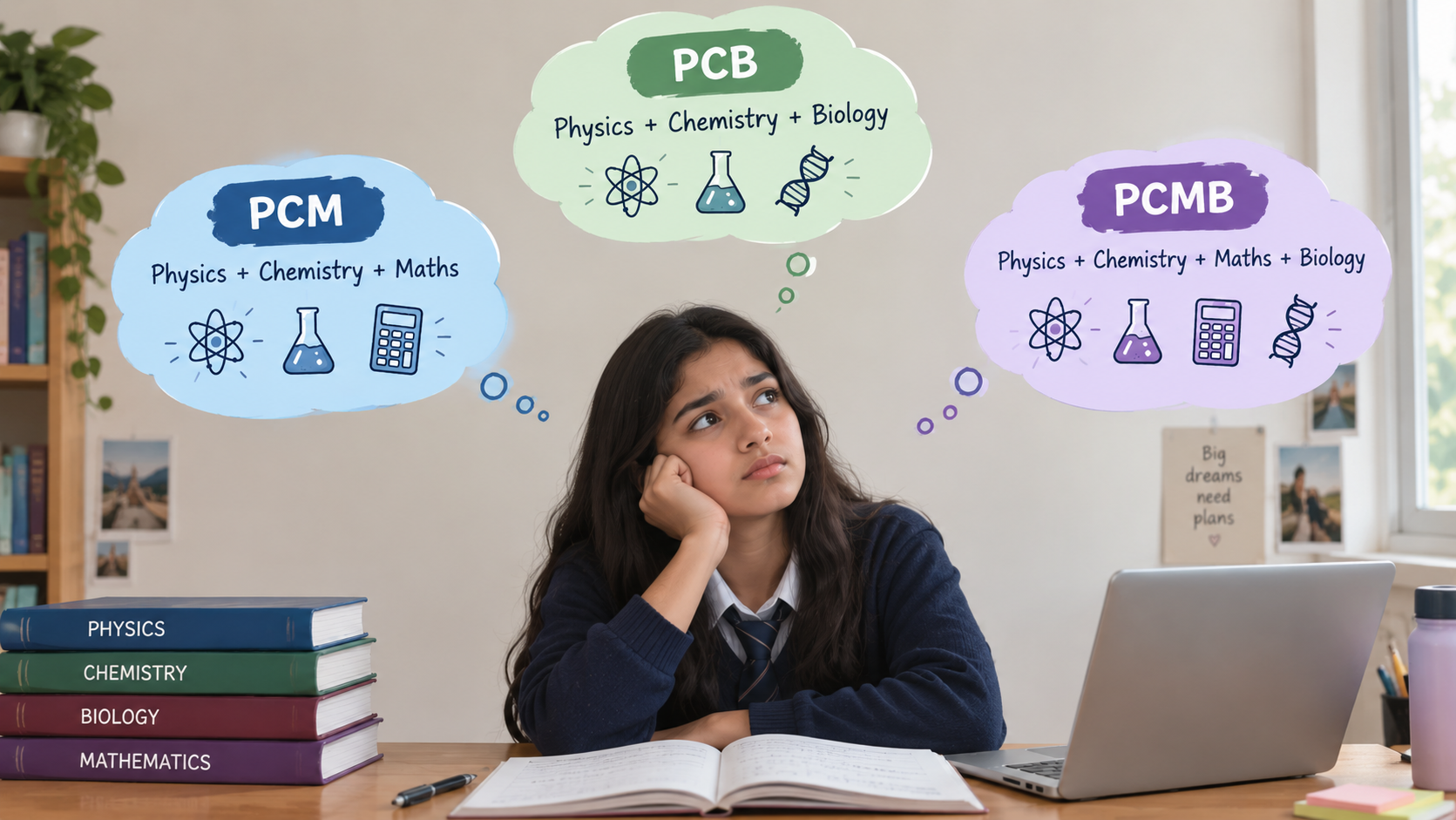
The stream your child picks for Class 11 quietly shapes which doors stay open. For example, B.Tech admission through JEE Main requires Physics and Mathematics in Class 12, while medicine through NEET-UG needs Biology (since 2023, it can also be cleared as an additional subject). Choosing between PCM, PCB, PCMB, Commerce or Humanities is therefore a career decision, not just a subject preference. Our guide on PCM vs PCB vs PCMB explains these trade-offs in detail.
The problem is that most teenagers make this choice with a very small map of the options:
-
A study of more than 10,000 students aged 14 to 21 found that 93% were aware of only seven careers, even though India has more than 250 career paths.
-
Across countries, the OECD found that nearly half of 15-year-olds expect to work in just 10 jobs, and that teenage aspirations often bear little relation to actual labour market demand.
-
In India, family members are the biggest single influence on career decisions (30%), followed by school teachers (13%), according to the UNICEF YuWaah Bharat Career Aspiration Report 2024.
Parents are doing their best, but few families have up-to-date knowledge of hundreds of careers, their entrance routes and how they are changing. That gap is what good career counselling fills.

Does Career Counselling Actually Work?
Career counselling is one of the better-researched areas of guidance, and the evidence is encouraging.
-
It improves decision-making confidence. A 2017 meta-analysis in the Journal of Vocational Behavior by Whiston and colleagues pooled 57 studies and found an average effect size of 0.35, a meaningful improvement. The biggest gains were in career decision-making self-efficacy, which is a student's confidence that they can make a good career choice.
-
The counsellor matters more than the test. The same study identified counsellor support as a critical ingredient. Activities such as values clarification and teaching students how to make decisions also had strong effects.
-
It is linked to better adult outcomes. The OECD analysed 12 long-term studies across 10 countries that followed teenagers into adulthood. Young people who had career conversations, met people in work, did workplace visits or job shadowing, and showed clearer career thinking at 14 to 16 tended to have lower unemployment, higher wages and greater job satisfaction 10 to 15 years later.
Yet access in India remains low. In the Bharat Career Aspiration Report 2024, only 9.36% of the 4,968 Class 9 to 12 students surveyed had received any career guidance. This is starting to change: a January 2026 CBSE circular requires affiliated schools to appoint a career counsellor for every 500 students in Classes 9 to 12. That is a big step forward, but at a ratio of 1:500, one-on-one time with each student will naturally be limited.
What Should a Good Career Counselling Session Cover?
A good session is not just a test followed by a PDF report. Based on the components that research links to better results, here is what you should expect:
-
A structured assessment before the session. Interest, aptitude and personality questionnaires give a starting point. On their own they are not a verdict; they are material for discussion.
-
One-on-one interpretation of the results. The counsellor should walk your child through what the results mean, where they fit and where they do not. This counsellor dialogue and support is where most of the value comes from.
-
Values clarification. What matters most to your child: creativity, stability, helping people, earning potential, working outdoors? Values often explain choices better than marks do.
-
Real information about the world of work. Careers that match, what the work involves day to day, which courses lead there, entrance exams, eligibility rules, typical timelines and costs.
-
Stream and subject mapping. A clear recommendation on stream and electives for Class 11, with the reasoning explained, plus a sensible backup option.
-
Time with parents. A short joint discussion so that parents and student leave with the same understanding and fewer arguments at home.
-
A written action plan. Next steps for the coming 6 to 12 months: subjects, skills to build, exams to note, people to talk to, and when to review the decision.
-
A follow-up. A check-in after a few weeks or at the start of Class 11 to adjust the plan.
Red flags to watch for
-
Guarantees of admission, ranks or a "perfect career match".
-
A session that ends with a sales pitch for a coaching package.
-
A long automated report with no one-on-one discussion of what it means.
-
Recommendations that ignore your child's interests and simply repeat what the parents want to hear, or the reverse.
-
A single career suggested with no explanation, no alternatives and no plan B.
School Counsellor, Online Test or Private Counsellor: Which Is Right for You?
Each option has a place. Here is how they compare:
|
School career counsellor |
Online aptitude test only |
Private 1-on-1 counsellor |
|
|---|---|---|---|
|
Cost |
Usually included in school fees |
Free to low cost |
Paid; varies widely |
|
Time with your child |
Shared; CBSE norms allow 1 counsellor per 500 students |
Self-paced, no human contact |
Dedicated one-on-one session |
|
Personal interpretation |
Limited |
None (automated report) |
Yes, in depth |
|
Parent involvement |
Occasional |
None |
Usually included |
|
Follow-up |
Depends on the school |
None |
Often included |
|
Best for |
General awareness, group workshops |
A first look at interests |
Students torn between streams or with specific goals |
A sensible approach for many families: start with a free tool such as the AI Career Predictor, make use of your school counsellor, and book a one-on-one session if your child is still undecided or if the stakes feel high.

When Is a Career Counsellor Worth It, and When Can You Skip It?
It is usually worth it if your child:
-
Is torn between two or more streams, for example PCM vs PCB or Science vs Commerce.
-
Does well in many subjects and cannot narrow down.
-
Has interests that differ from what the family expects, and you need a neutral voice.
-
Is curious about newer or less common careers such as design, data, psychology or biotechnology. Our guides to AI careers and Biology careers beyond MBBS are a good starting point.
-
Feels anxious or stuck whenever the topic comes up.
You may not need one if your child:
-
Has a clear, well-researched goal, knows the eligibility rules and entrance exams, and has spoken to people already working in that field. A quick eligibility check, such as our guide on how to get into engineering, may be enough.
How Should You Prepare for a Counselling Session?
A little preparation can double the value of a session. Before you go:
-
Collect your child's Class 9 and 10 report cards and any test results.
-
Ask your child to list subjects they enjoy, subjects they avoid, and activities they lose track of time doing.
-
Write down the careers each of you is considering, even the unlikely ones.
-
Agree as a family to keep an open mind until the session is over.
Questions to ask the counsellor:
-
What assessments do you use, and how will you explain the results?
-
How do you involve parents?
-
Which streams and electives would you recommend, and why?
-
What is the backup option if the first choice does not work out?
-
Which entrance exams and eligibility rules should we note now?
-
Will we get a written plan, and is a follow-up included?
For a broader look at all streams, including Commerce and Humanities, read our guide on how to pick your stream after Class 10.
The Bottom Line
Career counselling is not about handing your child a single "perfect" career. Done well, it widens their map of options, connects interests and values to real pathways, and turns a stressful family debate into a clear plan with a backup. The research is consistent: the human conversation, not the test report, is what makes the difference. If your child is about to choose a stream, that conversation is worth having now.
Frequently Asked Questions
1. When is the best time for career counselling?
Ideally in Class 9 or early Class 10, well before Class 11 stream selection. A second session in Class 11 or 12 helps with choosing courses, colleges and entrance exams.
2. Is an online aptitude test enough on its own?
It is a useful starting point, but research suggests counsellor support is the critical ingredient. A test tells you what your child scored; a counsellor helps them understand what it means and what to do next.
3. Should parents attend the session?
Yes, at least for part of it. Family is the single biggest influence on career decisions in India, so it helps when parents and children hear the same advice and leave with a shared plan.
4. Does my child's school have to provide a career counsellor?
CBSE schools are now required to appoint a career counsellor for every 500 students in Classes 9 to 12 under a January 2026 circular. ICSE and state board rules differ, so ask your school what support is available.
5. What qualifications should a career counsellor have?
There is no single national licence for career counsellors in India. Look for a relevant degree, such as psychology or education, specific training in career assessment, clear methods, and no link between their advice and selling coaching. For school counsellors, CBSE asks for a graduate or postgraduate degree in fields such as humanities, science or education.