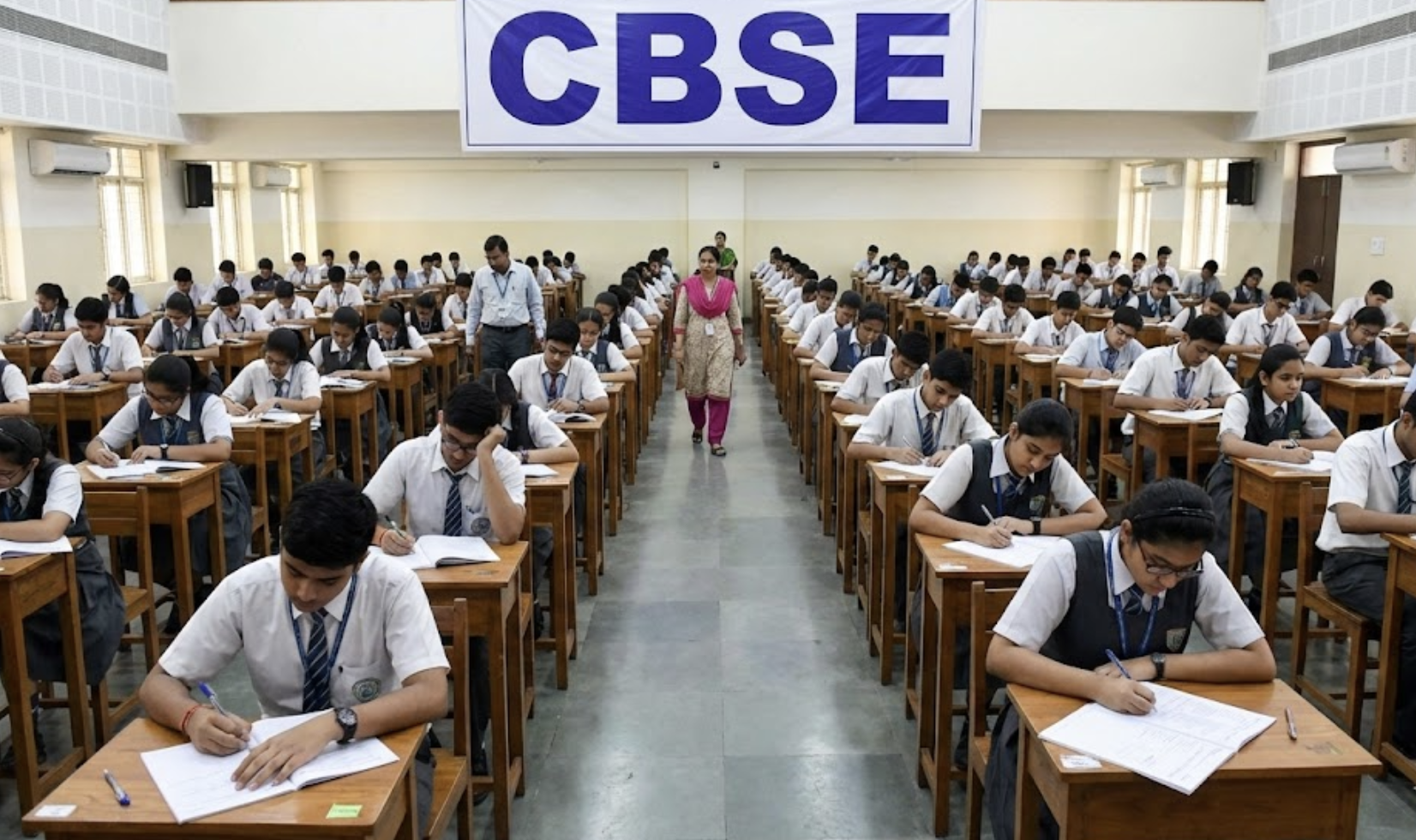

If your child is in Class 9 or 10, you have probably heard the chatter at the school gates: “CBSE boards happen twice a year now.” Close behind the news come the anxious questions. Is the second exam compulsory? Do both scores show up on the marksheet? Does this mean double the academic pressure, or a relief from it?
The change, driven by the National Education Policy (NEP) 2020 was designed to tackle exactly that pressure by lowering the stakes of a single exam day. The rationale is backed by hard data: a landmark 2022 NCERT survey revealed that over 80% of students in Classes 9 to 12 suffer from exam-related anxiety.
By introducing a second exam, the board aims to provide a safety net that drastically reduces this stress. With the first full cycle of this twice-a-year system now officially complete, here is what the policy actually means for your family’s preparation and peace of mind, minus the sensational headlines
How Does the New CBSE Biannual Exam System Work?
The Main Exam vs. The Improvement Window
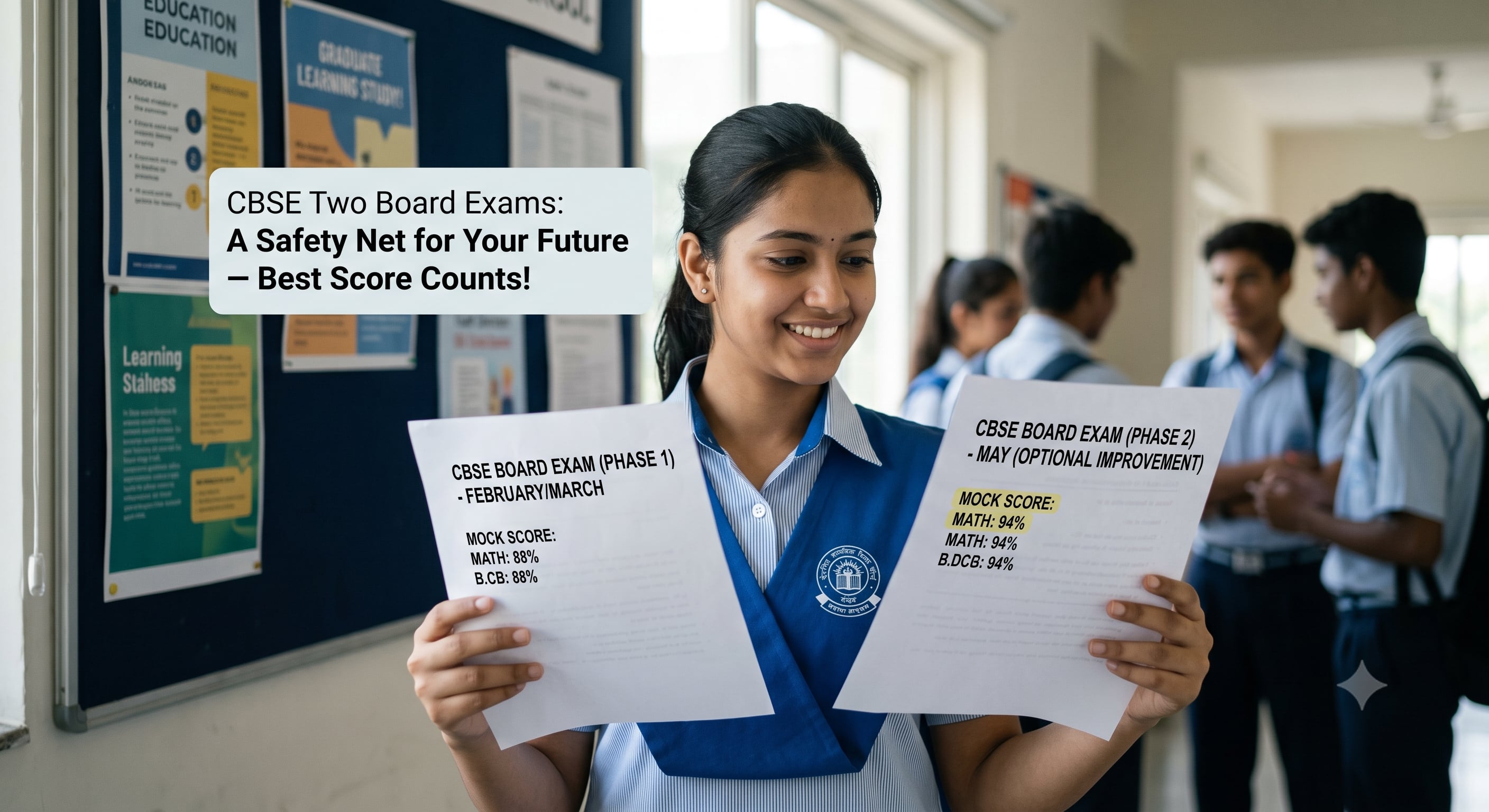
The main exam remains the anchor of the academic year, held in February and March. Every Class 10 student appears for this mandatory phase. For many families, this will be the only board exam their child writes.
The second exam, conducted around mid-May, is where the real change lives. It is entirely optional and serves primarily as an improvement window. A student who is unhappy with their subject scores can appear again in up to three subjects (from Science, Mathematics, Social Science, and Languages). Internal assessments are only conducted once, and those marks are carried forward, meaning the second sitting is purely about the written paper, not a repeat of the whole year.
Which Score Actually Counts?
The final marksheet reflects the best performance. There is no asterisk, no “second attempt” stamp, and no separate category of student. A score improved in May stands exactly as a February score does. If your worry was that using the second chance might somehow look weaker to future colleges, you can set it down.
By the Numbers: How Are Students Using the Second Window?
To understand the real impact of the policy, it helps to look at the official data from the 2026 exam cycle. Far from creating panic, the second window was heavily utilized by students targeting specific improvements.
According to data reported by The Hindu, out of the nearly 24.83 lakh candidates who took the main exams, over 6.68 lakh students opted for the mid-May exams.
Here is how students leveraged the second attempt:
-
The Improvement Majority: A massive 5,25,655 students (nearly 78% of the May test-takers) appeared specifically to improve their passing scores, rather than just clearing a failed paper.
-
STEM-Heavy Retakes: Students were highly strategic. The most retaken subjects were Science (4,74,491 students) and Mathematics Standard (3,68,843 students), showing that families are using the window to secure stronger scores for science-stream admissions in Class 11.
Should Your Child Take the Second Board Exam?
Not automatically. The healthiest way to use this system is to treat the February exam as the real one and the second window as insurance, considered only after results arrive in April. Three honest scenarios:
-
A clear miss in one or two subjects: A paper went badly and the score does not reflect your child's usual level. This is exactly what the second window is for.
-
A borderline score that affects stream choice: If a few marks in Maths or Science genuinely change your child's Class 11 options, a focused retake of that one subject can be worth the extra weeks of targeted preparation.
-
“Everyone is taking it, so we should too”: This is a trap. A child who performed to their preparation level gains little from rewriting papers, and loses a summer to it. More attempts is not the same as more learning.
What Actually Changes About Exam Preparation?
Less than the noise suggests. Strong fundamentals, steady revision, and calm exam habits matter exactly as much as before; the system changed, good preparation did not. What the second window rewards is targeted work: identifying the specific chapters where marks were lost, and rebuilding those, rather than revising everything in a panic.
That is also where most families need a second pair of eyes. A teacher who works with your child one-on-one can usually tell within a couple of sessions whether a retake is worth it, and where the marks are actually hiding.
The Final Takeaway
Two exams a year is not double the pressure; used well, it is a safety net that makes February less frightening. Decide about the second window after results, based on your child's actual papers, not the group chat.
And if you would like an expert to read on whether a retake makes sense for your child, and a focused plan if it does, Paathshala's mentors and counselors do exactly this. Book a session and walk in with clarity instead of guesswork.
Frequently Asked Questions (FAQs)
1. Is the second CBSE board exam compulsory?
No, it is strictly an optional improvement window. Students who are satisfied with their scores from the mandatory February phase can simply keep them and skip the May exams.
2. Can my child appear for just one subject in the second exam?
Yes. Students can choose to reappear for just one specific subject. Under current rules, eligible students can try to improve their scores in up to three subjects (out of Science, Mathematics, Social Science, and languages).
3. Does the marksheet show two attempts?
No. The final CBSE result reflects only the best score between the two attempts. It stands like any other mark, with no special stamps or indications of a retake.
4. When are the two CBSE board exams conducted?
The first (main) phase is conducted in February and March. The results for this phase are usually announced in April. The optional second phase takes place in mid-May.
5. Do schools conduct internal assessments twice under the new system?
No. Internal assessments and practicals are conducted only once during the regular academic session. Those marks are automatically carried forward if a student decides to take the written paper again in May.
6. Who is eligible to take the second board exam?
Any student who passes the main February exams can take the May exam for improvement. Additionally, students who fail in one or two subjects (placed in the 'Compartment' category) can use this exact same window to clear those specific papers.
7. Does taking the second exam delay Class 11 admissions?
The CBSE structured the timeline to minimize disruptions. With the second phase happening in May and results following shortly after (typically in June), schools adapt their provisional Class 11 admission processes to accommodate students utilizing the improvement window.