
There's a quiet worry that's settled into most Indian households right now — and if you're a parent, you've probably felt it too.
You watch your child staring at a screen for hours, and somewhere in the back of your mind, a question lingers: Is this enough? Is this the right kind of learning? And is my child going to be okay in a world that looks nothing like the one I grew up in?
AI isn't coming. It's already here. It's changing the way jobs work, the way companies hire, and the way knowledge is valued. And the uncomfortable truth? Academic marks alone won't be enough to navigate what's ahead.
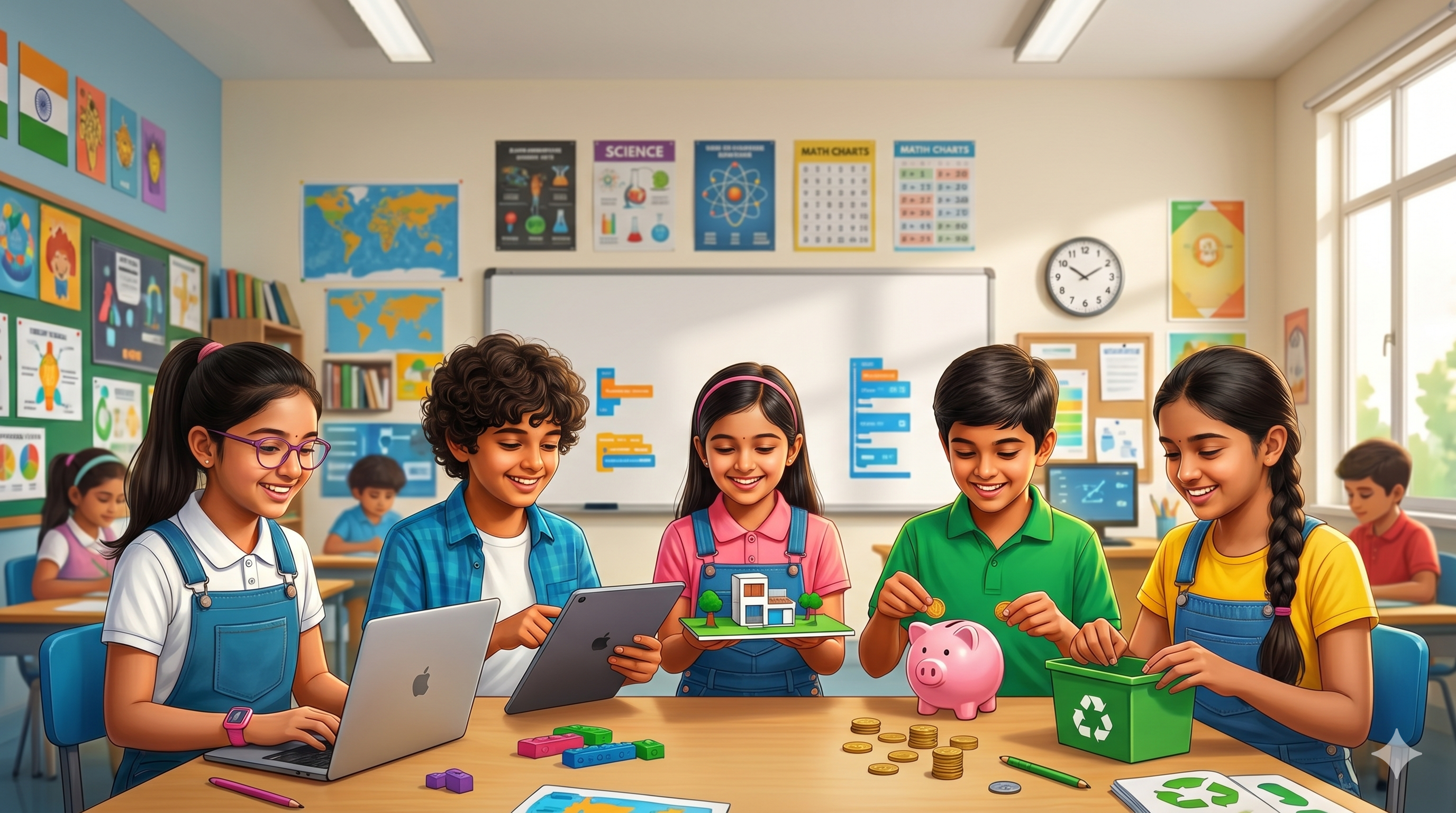
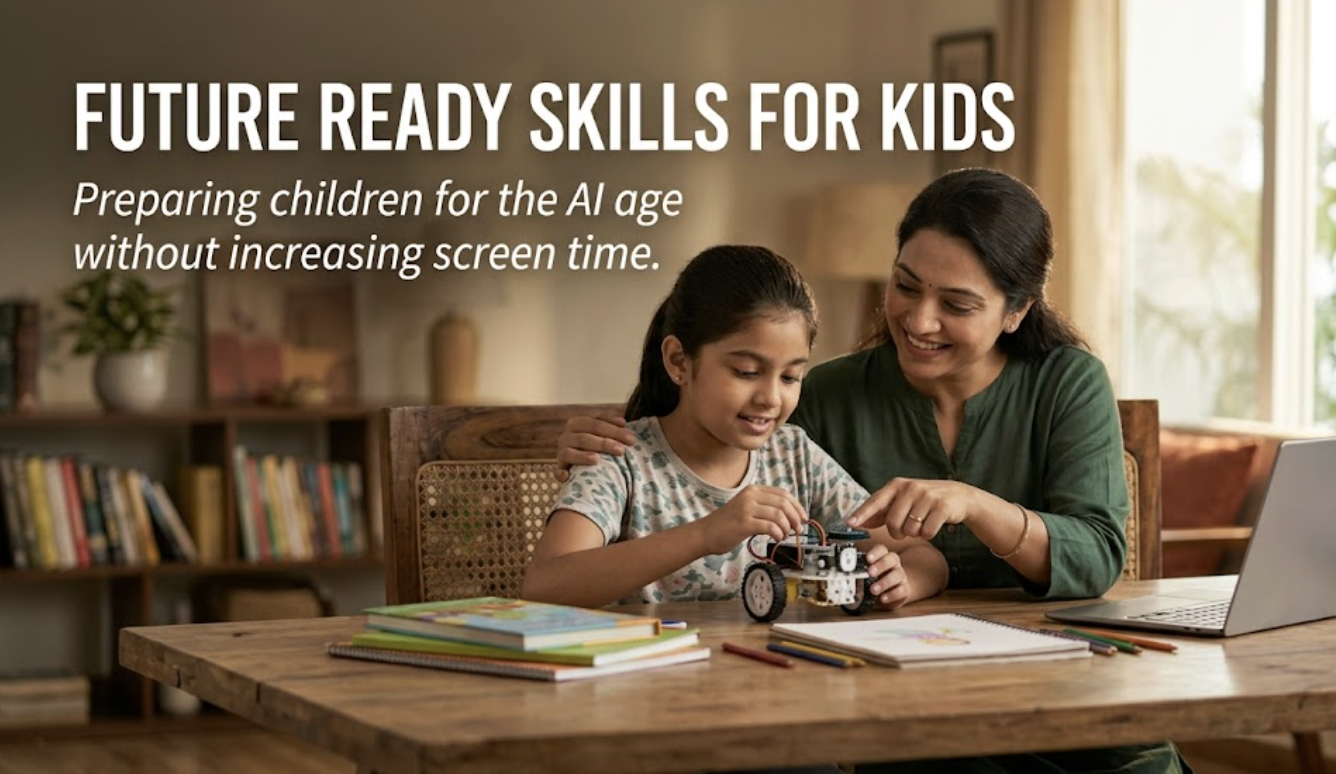
But here's what nobody tells you: preparing your child for the AI era doesn't mean loading them up with more coding apps or adding another screen to their day. It means something older, deeper, and far more human.
It means raising a child who can think, communicate, create, and connect — skills no algorithm can replicate.
This article is for the parent who is paying attention, asking the right questions, and looking for a grounded, honest path forward.
What You'll Find in This Article
- Why parents across India are rethinking what "a good education" actually means in 2026
- The 7 skills that will matter most in an AI-powered world — and why schools aren't teaching enough of them
- How extracurricular learning is quietly becoming the most important investment you can make
- Practical ways to build your child's skills without piling on more pressure or more screen time
- A platform worth knowing about if you're looking for structured, skill-based learning for your child
Why Parents Are Rethinking Education in 2026
Something shifted in the last couple of years. The conversations at school gates, in WhatsApp parent groups, in pediatricians' waiting rooms — they've changed.
It used to be: Which tuition centre is best? How do I improve my child's percentile?
Now it's: My child scores well but can't speak confidently in front of people. My child doesn't know what she's genuinely interested in. My son gets anxious the moment things get uncertain.
Indian parents are among the most invested in the world when it comes to their children's futures. And that same investment is now leading many of them to a sobering realisation: the academic pressure cooker that served previous generations is starting to show its cracks.
The National Education Policy (NEP 2020) pointed at this explicitly — it called for a shift from rote learning to holistic development, for skill-based learning to sit alongside academics, for children to be curious and capable rather than just exam-ready.
But policy takes time to trickle into classrooms. In the meantime, parents are stepping in.
They're asking: what does a truly future-ready child look like? And how do I raise one?
The Skills AI Cannot Replace
Let's be direct about what AI does well. It processes information at extraordinary speed. It can generate content, write code, analyse data, and solve structured problems faster than any human ever could.
But there's a category of ability it genuinely cannot touch — and this is where your child's competitive edge lives.
Communication
The ability to speak with clarity, warmth, and conviction is increasingly rare and increasingly valuable. Whether your child is presenting ideas, resolving a conflict, or inspiring a team, the person who can communicate well will always stand out. Public speaking skills, debate, storytelling, these are not "soft" skills. They are career-defining ones.
Creativity
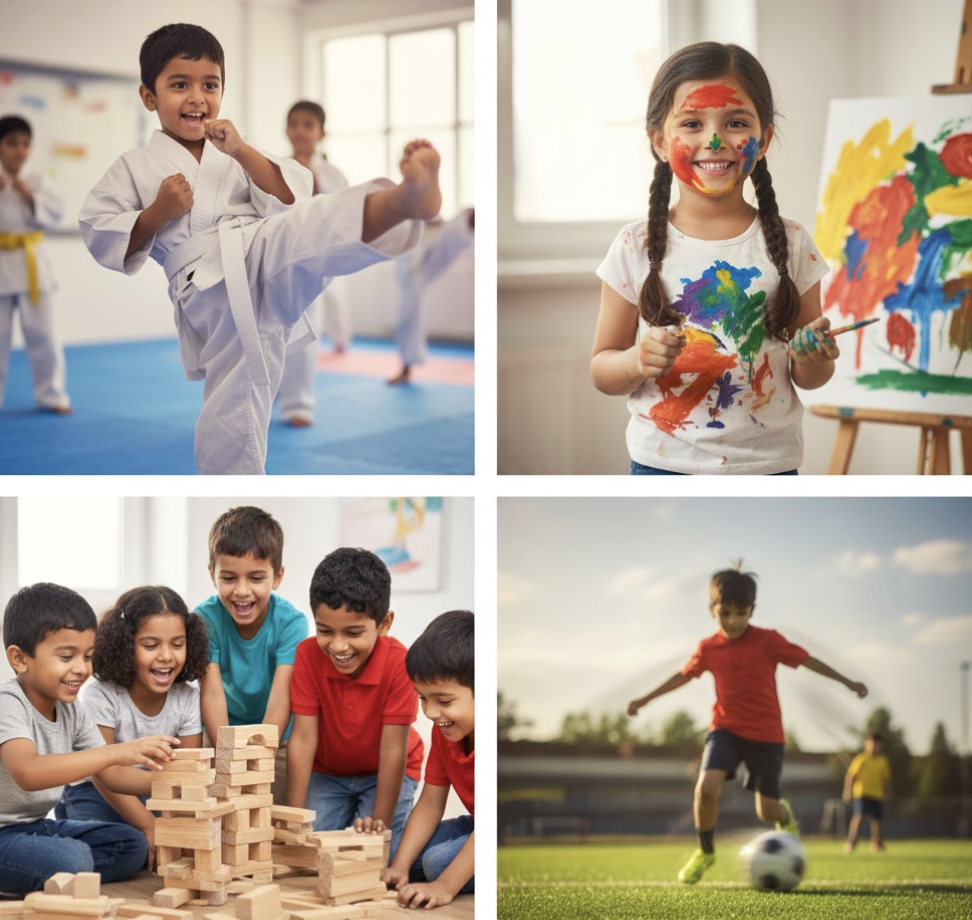
AI can remix and recombine. It cannot truly originate. A child who has been encouraged to create, to paint, write, choreograph, design, imagine develops a relationship with original thought that no tool can manufacture for them.
Emotional Intelligence
In a world where machines handle more transactional tasks, human beings will be hired for their ability to empathise, understand, and connect with other human beings. This isn't innate, it's built. Through relationships, feedback, collaboration, and emotional experiences. It's exactly why unstructured play and group learning environments matter so much.
Critical Thinking
Can your child question assumptions? Can they evaluate a claim before accepting it? Can they sit with a problem that doesn't have a clean solution? These are skills built through practice, through being asked "why?" more than "what's the answer?"
Confidence
Not the loud, performative kind. The quiet internal confidence that comes from having tried things, failed at things, and discovered that they're capable. This kind of confidence isn't given to children, it's built through experiences that challenge them in safe, encouraging environments.
Curiosity
Perhaps the most underrated trait of all. Curious children ask better questions. They stay engaged longer. They're more adaptable when the world shifts. And they grow up to be the kind of adults who learn throughout their lives, not just until the last exam.
Collaboration
Working well with others, sharing credit, disagreeing constructively, contributing to something bigger than yourself, is a skill that schools often mention but rarely teach deliberately.
These seven qualities are not produced by more homework or more test prep. They emerge from experiences, from exploration, from being given space to try things and from learning environments that value them.
Why Extracurricular Learning Matters More Than Ever
Here's a question worth sitting with: what does your child do between 5 PM and 9 PM?
For millions of Indian children, the honest answer is: screens. And not the productive kind, mostly passive consumption. YouTube, reels, gaming, sometimes WhatsApp. Time that passes without leaving much behind.
This is not a character flaw in your child. It's what happens when there's no better alternative readily available, and when children aren't connected to something they genuinely care about.
Extracurricular learning solves this problem in more ways than one.
It replaces passive screen time with active engagement. A child in a live dance class, or working on a drawing project, or rehearsing for a spoken English session, is still on a screen — but they're creating, not consuming. That distinction matters enormously for brain development, attention span, and emotional wellbeing.
It builds confidence in a way academics rarely does. When a child learns a skill and visibly improves at it, something shifts in how they see themselves. It's not about being the best — it's about the private satisfaction of getting better. That feeling transfers to every area of life.
It gives children an identity beyond marks. "I'm someone who dances." "I'm someone who draws." "I'm someone who can speak on stage." These identities matter. They give children a foundation to stand on when academic pressure mounts or results disappoint.
It reduces unhealthy screen dependency. Children who have hobbies and structured activities they look forward to naturally spend less time in mindless scrolling. You don't have to fight the screen as much when there's something more compelling available.
It opens unexpected doors. Some of India's most sought-after colleges and companies now explicitly value creative, well-rounded candidates. The child who plays the guitar, does Bharatanatyam, or codes a game for fun — they stand out. And they know it.
The search trends tell an interesting story here too. In the past week alone, Indian parents have been searching actively for online dance classes, online art classes, online music classes, online coding classes, and online drawing classes — all with search interest growing 20–40%. Something is clearly shifting in how parents are thinking about their children's learning.
How Parents Can Encourage Skill Development Without Overloading Kids
This is where good intentions can go wrong. Some parents, energised by all of the above, immediately sign their child up for five classes across five disciplines and wonder why their child burns out by week three.
Skill development works best when it's gradual, joyful, and chosen.
Start with interest, not aspiration
Don't start with "what skill will help my child's career." Start with "what does my child actually light up around?" The child who loves music isn't wasting time — they're building focus, pattern recognition, and emotional expression. Follow their curiosity first.
One meaningful activity beats three forced ones
A child who genuinely loves one dance class and attends with enthusiasm every week will grow more than a child stretched across four activities they're lukewarm about. Depth matters more than breadth, especially at younger ages.
Talk to them, not at them
Ask your child what they'd like to try. Let them feel some ownership over their learning. A child who chose their own activity is far more likely to persist through the harder weeks.
Celebrate effort, not just performance
If your child comes home excited that they finally got a move right, or finally wrote their first poem, or spoke without forgetting their lines — that's the moment to celebrate. Not the certificate. The doing.
Create a rhythm, not a schedule
Children thrive on predictability. When a skill class happens at the same time each week, it becomes part of life rather than an addition to it. The anxiety around "fitting it in" drops significantly once it's simply part of the routine.
Protect rest
No child develops well without genuine downtime. Unstructured play, time with family, boredom that leads to imagination — these are not wasted time. They're essential.
Looking for a Good Platform? Here's One Worth Checking Out
If you're a parent exploring where your child might build some of these skills, Paathshala is worth taking a look at.
It's an online learning platform designed specifically for children who need more than academics — a place where skill-based learning, creative exploration, and real confidence-building can happen without the pressure of a traditional classroom.
What makes it stand out is the combination of live, interactive online classes with a wide range of extracurricular categories — from performing arts and creative writing to communication and life skills. Classes are designed to fit into a family's actual schedule, not an ideal one.
Parents who've used it often mention the same things: that their child looks forward to their classes, that they've noticed a visible improvement in their child's communication, and that it has replaced a chunk of passive screen time with something genuinely valuable.
It's not about doing more. It's about doing the right things — in an environment that's encouraging rather than competitive, and structured enough to produce results without feeling like another pressure to manage.
If you're exploring options, their piece on the best online summer classes for kids is a good starting point — it covers different activity categories, what to look for in an online class, and how to think about choosing the right fit for your child's age and interests.
Wrapping Up
Here is what we know for certain: the children who will thrive in the coming decades are not the ones who scored the highest on their board exams. They are the ones who know how to think, feel, communicate, create, and keep learning.
AI is not the enemy of your child's future. It's actually a reason to double down on the things that make us irreplaceably human — and to raise children who lead with those qualities.
You don't need to panic. You don't need to overhaul everything. You just need to start noticing — what is your child genuinely curious about? What makes them come alive? What skill, if they practised it for a year, might quietly change how they see themselves?
Start there.
The world ahead will reward curious, confident, creative humans. And your child — the one you're already worrying about, already investing in, already showing up for — is already more ready than you think.
You just need to give them the right experiences to discover that.
Frequently Asked Questions
Q: What are the most important future-ready skills for kids today?
The skills that matter most in an AI-powered world are the ones machines struggle to replicate: critical thinking, emotional intelligence, creative problem-solving, clear communication, and genuine confidence. These aren't built through more academic study — they develop through experiences, exploration, and environments that encourage children to try, fail, and grow.
Q: How much screen time is too much for kids?
Most child development experts suggest limiting recreational screen time to 1–2 hours per day for school-age children. But the quality of screen time matters as much as the quantity — active, creative, or social engagement online is very different from passive consumption. The goal isn't to eliminate screens but to ensure most of your child's screen time is doing something for them, not just to them.
Q: Are extracurricular activities really important for a child's development?
Yes — significantly. Extracurricular activities build skills that structured academics rarely develop: confidence, creativity, teamwork, and resilience. They give children an identity beyond marks, reduce unhealthy screen dependency, and can open doors academically and professionally. The key is finding activities your child genuinely enjoys, not ones that feel like another obligation.
Q: How is AI changing education for children?
AI is automating many of the skills traditionally taught in schools — memorisation, information retrieval, basic calculation. This is actually an opportunity, not just a threat: it frees education to focus on deeper human capabilities. Schools and platforms that embrace this shift are preparing children for the real future. The focus is moving towards creativity, collaboration, and critical thinking.
Q: Are online classes effective for skill development in kids?
When done well, yes. The most effective online classes for children are live and interactive (not pre-recorded), taught by skilled instructors who understand child development, structured with clear progression, and connected to something the child actually cares about. Look for platforms where your child is engaged, not just occupied.
Q: How do I build confidence in my child without pushing them too hard?
The most effective path to confidence is through competence — helping your child get genuinely good at something they care about. Choose one activity to start, celebrate progress over performance, let them struggle productively without rescuing them immediately, and create space for them to talk about what they're feeling. Confidence isn't given — it's built one small win at a time.
Q: How do I choose the right extracurricular activity for my child?
Start with your child's expressed interests rather than what seems impressive. Let them try a few things before committing to one. Look for environments where the instructor genuinely connects with children, where there's a clear structure but also room for fun, and where your child comes home energised rather than drained. The best activity is simply the one your child will actually keep doing.